
A small, decorated box reveals the intimate details of a life long past.
The cosmetic box of the royal butler Kemeni, which dates to 1805 BCE, serves as a tangible bridge to the grooming habits of the Middle Kingdom. Rather than a modern makeup bag, this object represents a specialized toolset for personal care, showing that organized grooming was a distinct aspect of life for those in royal service. Excavation evidence confirms that such containers were designed to house specific, precious substances, pointing toward a structured routine of hygiene and aesthetic maintenance.
Scholars analyze these artifacts to understand how personal presentation functioned within Egyptian social hierarchies. While the box provides a clear physical link to the past, the exact nature of the substances it held remains a subject of investigation. We know from the presence of such specialized containers that individuals like Kemeni valued the preservation of their tools, yet the specific chemical composition of what he placed inside remains a point of scientific study rather than assumed certainty.
This artifact is a primary piece of evidence for the existence of organized grooming regimens, yet it is important to distinguish between the existence of the container and the specific purpose of the materials it held. Archaeological reports from the Middle Kingdom allow researchers to infer that such boxes were used for grooming, but they do not provide a complete manual on the daily application techniques or the specific ingredients favored by the owner. The gap between the physical tool and the application practice is where the most rigorous analysis currently lies.
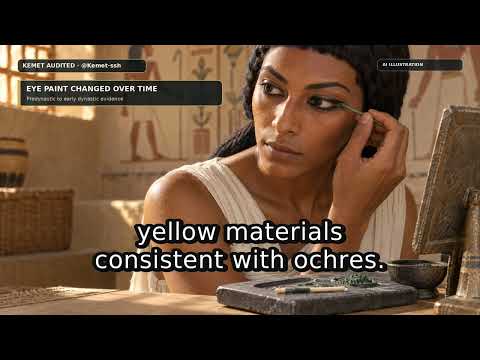
How did the composition of eye paint change through the centuries?
Dark, sweeping lines around the eyes appear in countless Egyptian depictions, but the substances used to create them evolved significantly over time. Evidence from various archaeological sites suggests that the materials used for eye paint were not static throughout the history of the civilization. For instance, researchers have identified that green eye paint was more frequently utilized during the Predynastic period, whereas black, lead-based kohl became the predominant choice during later Dynastic periods.
This shift suggests that cosmetic choices were influenced by the availability of materials and perhaps by changing cultural standards. Recent analytical findings, including a 2022 study of 11 distinct kohl containers, demonstrate that the contents of these vessels were far more varied than a single black, lead-heavy powder. These studies indicate that the recipes for eye paint were diverse, reflecting a sophisticated interaction with mineralogy. The evidence directly shows that the mixtures were complex, but it remains unknown whether these variants were based on personal preference, local availability, or specific medicinal intent.
It is a common misconception that ancient Egyptians used a single, universal recipe for their eye adornments. The chemical data argues against this, showing that variations in composition occurred across different social contexts and time periods. When observing artifacts from these eras, one must recognize that the dark pigments seen in artwork might be composed of entirely different mineral foundations depending on the century of their creation. Scholars infer that this chemical variability suggests a nuanced knowledge of the materials, yet the exact social drivers behind these changes remain a subject of active research.
What was the real purpose of the mysterious wax cones?
Small, cone-shaped forms often appear perched atop the heads of individuals in Egyptian tomb paintings, leading many to speculate about their function as melting, perfumed hair waxes. However, modern scientific analysis has provided a more nuanced perspective on these enigmatic objects. A peer-reviewed study utilizing spectroscopy to analyze these items has identified that the primary constituent of the cones discovered at Amarna was biological wax, rather than fats or incense.
This discovery shifts the understanding of these items away from the theory of daily hair grooming. Some scholars now argue that the presence of these cones, particularly those linked to afterlife rituals, suggests they served a symbolic or liturgical purpose rather than a practical, cosmetic one. The evidence does not support the claim that they were standard hair balms used in everyday life, and researchers are careful to avoid labeling them purely as cosmetic accessories. The distinction remains critical; whereas paintings imply a common grooming practice, the material evidence suggests something far more specialized.
The discrepancy between the artistic representation and the chemical reality of these cones highlights the dangers of taking tomb imagery at face value. While the paintings depict them as part of a celebratory or cosmetic scene, the material evidence from the Amarna period (roughly 1347–1330 BCE) forces us to consider that these objects were meant for the grave, not for a daily beauty routine. The precise nature of these rituals remains a subject of ongoing debate in Egyptology, as the archaeological record lacks a clear manual for their intended use in the transition to the afterlife.
What role did ochre pigments play in daily life?
The vibrant colors found on tomb walls and in cosmetic vessels were often derived from the earth itself. Excavation reports from the 1930s at the site of Amarna brought to light a collection of raw, unrefined pigments that had remained untouched for millennia. Subsequent chemical analysis identified these materials as iron-rich red and yellow ochres, minerals that were readily available and widely used in the Egyptian world.
These findings illustrate that the ancient Egyptians were masters of their environment, sourcing materials directly from the landscape to serve their aesthetic and ritual needs. While ochre is frequently associated with wall art, the presence of these raw materials near cosmetic areas suggests they served multiple roles, including the decoration of skin or the application of pigments to surfaces within the home.
The evidence suggests that raw minerals like ochre were processed into diverse forms for various purposes, but we must be careful not to assign a singular function to these pigments.
Some researchers infer that the preparation of these pigments was a specialized skill. The transition from raw earth to a fine, usable cosmetic powder required knowledge of grinding and binding, which implies that the ancient beauty industry was supported by a network of skilled practitioners. This process is documented by the presence of grinding stones and mixing palettes found alongside the pigments in residential quarters. While we see the tools for preparation, the social status of those who performed this labor remains largely undocumented in the archaeological record, representing a significant area of future inquiry.
How do we interpret the specialized vessels for ointments and perfumes?
Beyond the materials themselves, the vessels used to store them provide a rich, if sometimes ambiguous, narrative of ancient lifestyle. A Middle Kingdom vessel excavated from the tomb of Sithathoryunet serves as a primary example of this, as it is widely believed to have contained skin salves or specialized ointments. The craftsmanship of these containers, such as the small perfume bottle from the Amarna period, underscores the high level of artistic effort invested in grooming objects.
However, there is a clear distinction between the existence of a high-quality vessel and the definite identity of its previous contents. While archaeologists often categorize these items as ointment or perfume jars, this is frequently based on the shape of the container rather than a chemical analysis of residual traces. This creates a gap in our knowledge: we can define the aesthetic importance of the container, but we cannot always definitively state what was inside. The presence of such diverse vessels suggests that different substances, from oils to thick pastes, were stored with specific intent, yet the exact chemical fingerprints of these substances are often lost to time.
Scholars must proceed with caution when examining these artifacts. The diversity of vessels found across different sites suggests that different substances were stored in specific containers. By studying the residue within these jars, where it survives, scientists are slowly beginning to map the chemical reality of these beauty products, though many vessels remain empty or contaminated, leaving their original contents a mystery. This uncertainty highlights why we must be careful not to assume that every vessel labeled as a "perfume jar" served that specific, singular function.
Why does the evidence vary so much across time and location?
A persistent challenge for historians is the assumption that Egyptian culture was a monolith, a singular, unchanging entity that lasted for three millennia. The archaeological record proves otherwise, showing that cosmetic practices were subject to regional shifts, societal trends, and the influence of changing ruling dynasties. The beauty kit of an elite resident in the Old Kingdom would likely have differed in both composition and container design from one belonging to a New Kingdom official.
Location also played a massive role in the availability and use of materials. Residents of major urban centers like Amarna or Thebes had access to different trade routes and therefore different pigments and perfumes than those living in more rural areas. This regionality suggests that personal grooming was a fluid practice, governed by trade, local environmental resources, and individual status. While the tools for grooming were widespread, their quality and complexity varied significantly, potentially mirroring the social stratification of the time.
Scientific rigor requires us to view these variations as evidence of a complex, evolving culture. Rather than seeking a universal Egyptian beauty standard, we should examine these artifacts as part of a localized, chronological timeline. The documentation provided by excavation reports allows us to build a more accurate map of these practices, showing that the definition of beauty was as dynamic as the civilization that produced it. We must account for the fact that archaeology only captures a fraction of what was likely a vast array of ephemeral substances used in daily life.
Why does this material evidence matter to our modern understanding?
The study of these artifacts matters because it bridges the gap between the monumental history of pharaohs and the personal, human history of the individuals who lived and worked in their shadow. By looking at a grooming box or an ochre pigment, we are witnessing the intimate moments of ancient life. This perspective provides a necessary corrective to the often-romanticized or misinterpreted depictions of Egyptian beauty in modern media.
Scientific analysis does not diminish the beauty of these artifacts; rather, it makes them more human by revealing the physical labor and ingenuity involved in their creation.
Understanding the reality behind the cosmetic tools allows us to appreciate the sophistication of ancient scientific inquiry. The way the Egyptians sourced, processed, and utilized these materials reflects a deep understanding of natural resources. When we rely on evidence-based research, we move away from speculation and toward a more accurate portrayal of how these people interacted with their environment and with each other. It is through the systematic analysis of these small, utilitarian items—such as combs, mirrors, and kohl tubes—that we begin to understand how the aesthetic and the practical were balanced in the daily lives of the ancient people.
Where can we look for the next phase of discovery?
The field of archaeological science is rapidly evolving, and new techniques are opening doors to information that was previously unreachable. Future research will likely focus on more advanced mass spectrometry to identify the chemical signatures of residues inside ceramic and glass vessels, providing concrete data on the composition of ancient ointments and perfumes. This could reveal not only the ingredients but also the origins of the materials used in the beauty kits.
Additionally, looking at the spatial distribution of cosmetic tools within newly excavated domestic spaces will provide a better understanding of how these items were used in the home. By analyzing where the tools were stored and how often they were replaced, researchers can begin to understand the rhythm of daily grooming practices. The study of these items is far from complete, and each new find provides a chance to refine our existing theories. We must remember that while archaeological findings suggest a range of grooming habits, the exact rituals surrounding their use—and the degree to which they were strictly medical versus purely aesthetic—remains an ongoing scholarly debate.
For those interested in exploring this topic further, excavation reports from major museums provide the most reliable accounts of how these objects were recovered and identified. By turning to the primary archaeological data, we can continue to peel back the layers of myth and misconception surrounding the beauty kit of ancient Egypt, leaving us with a clearer, more fascinating picture of the past. The physical tools—the mirrors, the applicators, the palettes—are silent witnesses to a culture that valued the intersection of beauty, health, and ritual in ways that we are only beginning to decode through the lens of modern science.
Watch the Kemet filmFirst published on Kemet (kemet-stories.pages.dev) · reference KMT-639FC7
← Back to the archive