
What do we actually see when we look at the art of the Nile?
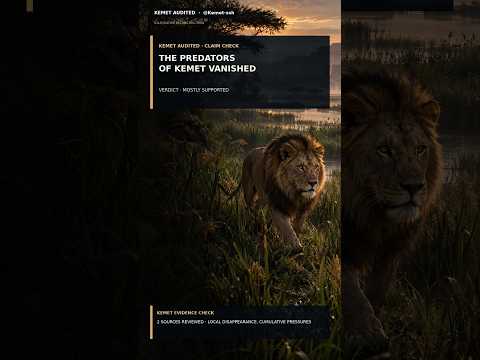
The gilded tomb walls and stone reliefs of Egypt often depict a world teeming with life that appears foreign to the modern landscape of the region. Where today we see desert and agricultural strips, historical art reveals a vibrant past populated by apex predators and a wide variety of herbivores. According to the study Egypt’s Mammal Extinctions Tracked Through 6,000 Years of Art, researchers have utilized these historical depictions to build a comprehensive data set. By analyzing artistic representations found throughout six millennia of history, scientists can reconstruct what the animal kingdom looked like before the shift toward human dominance.
While these images provide a vivid window into the past, they are more than mere cultural records. They serve as a primary source of data for paleontological research. Scholars have used this artistic evidence to trace the disappearance of various species, effectively creating a timeline of ecological change. By documenting which animals appeared frequently during different dynasties and comparing that with the eventual absence of those same animals in later records, the researchers established a baseline for when these populations began to dwindle. It is important to note that while this evidence shows a clear trend of disappearance from the artistic record, scholars must infer the specific reasons for these absences, distinguishing between a species that was genuinely extinct in the region and one that was simply no longer being recorded or favored by the artists of a particular era.
How did a stable ecosystem lose its balance over six thousand years?
An ecosystem functions like a complex web, where every species relies on the stability of others to maintain balance. As the study titled Collapse of an ecological network in Ancient Egypt explains, researchers tracked mammal extinctions over a 6,000-year period to see exactly how this web unraveled. Initially, the system demonstrated a degree of resilience. When some herbivores were removed from the landscape, the predators did not immediately suffer, as there remained enough diversity in the prey population to sustain them.
The turning point occurred when the loss of species reached a critical threshold. According to the report Study traces ecological collapse over 6,000 years of Egyptian history, the primary factor was the loss of "ecological redundancy." This term describes the ability of an ecosystem to maintain its functions because multiple species can fulfill the same role. As the number of available species dwindled, this redundancy vanished, leaving the food web increasingly unstable. Once the variety of prey animals reached a certain low point, the predators could no longer find enough sustenance, leading to a cascade of population declines. This mechanism suggests that the ecosystem was not destroyed by a single event, but rather by the slow, iterative erosion of the biological safeguards that kept the food web functional. The evidence directly shows that as the variety of prey shrank, the predator population lost its ability to adapt, yet the exact point at which an ecosystem transitions from stable to terminal remains a subject of intense scientific inquiry.
Can we distinguish between migration and total extinction?
One of the most persistent questions in this field involves the fate of the displaced animals. Did the predators move to neighboring regions as the environment changed, or did they face total extinction within the Egyptian territory? While computer models are excellent at showing that these species disappeared from the local landscape, they do not always clarify if the animals moved elsewhere. This remains a complex area of study because the models prioritize the loss of species from the Egyptian food web rather than the movement patterns of individual animals.
Current research often struggles to determine the exact moment a species ceased to be a presence in the Nile Valley. While the broad 6,000-year timeline gives us a framework, there is an ongoing need for refinement regarding the specific dates of disappearance. Some scholars argue that certain predators likely migrated to adjacent regions as their habitat dried up, but there is no consensus on how many animals successfully relocated versus how many succumbed to the pressures of a changing environment. This uncertainty is critical because it changes our understanding of the collapse: if the animals simply migrated, the event is a story of habitat shift; if they faced extinction, it is a story of catastrophic biological loss. The available data currently supports the tracking of the disappearance, but it does not yet provide the granular details required to definitively prove the location of the populations after they departed from the Egyptian Nile Valley.
How did a drying climate and human growth turn the tide?
The environment of the Nile Valley was not static, and its transformation is a key component of the predator decline. According to computer modeling used to reconstruct ancient predator-prey dynamics, the region underwent significant geological and climatic changes over the last 6,000 years. As the climate grew drier, the lakes and grasslands that served as the hunting grounds for large predators began to shrink. This climate shift made it much harder for the entire food chain to survive, as even minor changes in the availability of water could trigger a significant impact on the ecosystem.
The decline of large mammals in Egypt is linked to the combination of a drying climate and an ever-growing human population.
This environmental stress was compounded by the increasing human footprint along the Nile. As the population grew, the competition for land and resources intensified, leaving even less space for wild species to roam or hunt. The evidence suggests that it was this cumulative pressure—the convergence of climate change and human expansion—that made the landscape uninhabitable for large predators. The ecological systems that had once supported a rich variety of life simply collapsed under the weight of these two primary, persistent forces. Scholars infer that the human role was not merely the hunting of these predators, but the transformation of the landscape into an agricultural zone that could no longer support the range requirements of wild, apex animals. Whether the primary driver was the environmental change or the human encroachment remains a matter of interpretation, as both pressures were occurring simultaneously across the 6,000-year timeline.
What is the state of current fieldwork in the region?
Archaeological projects today are refining our understanding of these ancient landscapes by using sophisticated, non-invasive technology. The Penn Museum and Egyptian archaeologists have been engaged in ongoing fieldwork at Abydos, a site that continues to offer clues about the physical reality of ancient Egypt. Excavations at this location have been in progress since 1967, and current efforts are scheduled to continue through 2025. This long-term research is essential because it allows scientists to ground their abstract models in the physical findings of the earth.
Recent efforts at sites like Anubis Mountain have employed state-of-the-art surveying tools to map the terrain. By utilizing remote sensing, magnetometry for magnetic mapping, and photogrammetry for three-dimensional modeling, researchers have mapped 10,000 square meters of terrain. These technological advancements enable archaeologists to find historical evidence that was previously unreachable. As this data is integrated into the 6,000-year timeline, researchers can more accurately pin down the chronology of environmental changes, helping to bridge the gap between archaeological discovery and ecological theory. The importance of this fieldwork lies in its ability to reveal the environmental context of these ancient tombs and settlements. By mapping the terrain, researchers can visualize the landscape as it existed when the predators were still present, providing a physical anchor to the artistic and modeled data.
Which specific predators were most affected by these changes?
There is still an ongoing debate regarding the exact identification of the apex predators that were hit hardest during specific climatic turning points. While it is clear that the network as a whole collapsed, the details of which animals disappeared first—and which were the most resilient—are still being clarified. Paleontological research relies on the integration of these artistic records and modern geological data, but the record is not always as precise as we would like.
Because the historical art acts as a proxy for the presence of these animals, scientists must navigate the limitations of what the ancient Egyptians chose to document. If a predator was rarely depicted in art, its true population numbers in the wild remain difficult to estimate. Consequently, the specific role and eventual disappearance of certain species remain a subject of investigation. As new findings emerge from digs like those at Abydos, researchers hope to fill these gaps and paint a more complete picture of the predators that once roamed the Nile. There is a distinct difference between the evidence of a species' presence in art and the statistical certainty of its population density. Scholars are cautious about over-interpreting the artistic depictions, acknowledging that the absence of a predator in a specific dynasty's tomb art might indicate a change in cultural priorities rather than the actual extinction of that predator in the wild.
Why does the story of a lost ecosystem matter today?
The history of Egypt’s predators serves as a cautionary study in how delicate an ecosystem can become once its redundancy is stripped away. By looking at the 6,000-year decline, we gain perspective on the long-term impact of human activity on the environment. Understanding how the loss of smaller species eventually crippled the apex predators provides a clear lesson on the interconnected nature of survival. It demonstrates that the stability of a landscape is not guaranteed and that even subtle, cumulative changes can lead to the collapse of once-thriving systems.
Ultimately, the study of Egypt’s past is not just about archaeology or dead kingdoms; it is about recognizing the patterns of environmental change that affect all living things. When we look at the work being done at Abydos or analyze the data from historical art, we are looking at the consequences of a changing world. This evidence matters because it provides us with the tools to look at our own changing landscapes, helping us identify the early signs of instability before the web of life loses its capacity to support the diversity we see today. The lesson here is that an ecosystem may appear healthy long after it has lost its necessary ecological redundancy, masking the fact that it is nearing a point of irreversible collapse.
The loss of ecological redundancy made the food web increasingly unstable, eventually causing a cascade of population declines.
What should you watch for next?
The integration of new archaeological data from Abydos into existing ecological models is the next major step for researchers. As the excavations continue through 2025, the focus will remain on refining the 6,000-year timeline to better understand how specific climate events correlated with the loss of individual species. Keep an eye on new publications from the Penn Museum and other major institutions, as they are expected to yield further insights into the specific terrain of Anubis Mountain.
For those interested in the cultural side of this research, observing the upcoming analysis of new discoveries at these sites will be vital. Scientists are likely to focus on how ancient societies documented the shifts in their environment, potentially giving us new clues about how the human population adapted to the loss of the predators that once shared their world. The story of the Nile’s missing predators is far from settled, and the coming years of fieldwork will likely provide the missing pieces to this ancient ecological puzzle. By continuing to combine the physical findings from the ground with the artistic evidence found in the tombs, researchers aim to reach a clearer understanding of the timeline of these extinctions, ultimately helping us determine how much of this loss was a result of inevitable environmental shifts versus the direct influence of a human society expanding across the river valley.
Watch the Kemet filmFirst published on Kemet (kemet-stories.pages.dev) · reference KMT-B05D23
← Back to the archive