
When did the first wheels of war arrive in the Nile Valley?
The arrival of the chariot in Egypt marks a significant turning point in the history of the Nile Valley, yet it was not an indigenous invention. According to a depictional study of chariot use in New Kingdom Egypt published by the American University in Cairo, this technology was introduced toward the end of the Second Intermediate Period, roughly between 1650 and 1549 BC. This era, specifically during the 17th Dynasty, saw the Theban kings beginning to adopt the vehicle, likely in response to interactions with foreign powers. Before this period, Egyptian warfare was almost exclusively dominated by infantry, making the introduction of horse-drawn transport a radical shift in how the state protected its borders and projected its power.
Scholars note that the introduction of the chariot was not merely a military upgrade but a cultural and technological shock. The evidence from the 17th Dynasty suggests that the adoption was gradual, as the Egyptian military had to master not only the construction of the vehicles but also the breeding and training of horses. The American University in Cairo study highlights that the depictional record—the way chariots were drawn on tomb walls and temples—shows an increasing sophistication in how they were integrated into the Egyptian identity. By the time the New Kingdom was fully established, the chariot had moved from a foreign curiosity to a central symbol of the Pharaoh’s authority.
What remains a subject of ongoing research is the exact path of this technological transfer. While the 17th Dynasty is credited with the initial use, the specific resources required to maintain a fleet of these vehicles suggest a highly organized logistical network. Researchers infer that the sudden appearance of the chariot necessitated new types of craftsmen, from wheelwrights to specialized leatherworkers. This transition period serves as a bridge between the relatively isolated Middle Kingdom and the more expansionist, internationally connected New Kingdom, where the chariot would eventually become the primary tool of the elite military class.
How did advanced engineering create a high-speed archery platform?
The physical construction of the Egyptian chariot was a marvel of Bronze Age engineering, focused on reducing weight to maximize speed and agility. According to research papers hosted on Academia.edu and general consensus in Egyptian chariotry studies, these were lightweight, two-wheeled vehicles drawn by a pair of horses. Unlike the heavier, more cumbersome wagons of other cultures, the Egyptian design was optimized for the specific conditions of the Near Eastern landscape. The video documentation of these vehicles highlights the use of spoked wheels, a crucial innovation that provided structural integrity while removing the bulk of a solid wooden disk.
Excavation reports and archaeological studies of surviving artifacts reveal a complex mix of materials. While wood formed the frame, leather played a critical role in the vehicle's functionality. According to reports from Ahram Online, archaeological teams are currently studying leather fragments to understand the specific technology used in chariot construction. This leather was likely used for the flooring of the chariot cab to provide a suspension-like effect for the riders, as well as for the harnesses and potentially even parts of the bodywork. The use of bronze or stiffened leather for scale armor on the crew members further illustrates the balance between protection and the need to keep the vehicle light enough for rapid maneuvers.
There is an interesting tension in the evidence regarding how long this technology had been in development. While the New Kingdom is the era of the chariot’s peak, Ahram Online reports that an archaeological team is studying leather fragments from the Old Kingdom. This discovery raises the possibility of proto-chariot technology or early equestrian gear existing in Egypt long before the 17th Dynasty. However, most scholars currently agree that the fully realized war chariot as a tactical unit is a hallmark of the later periods. The exact timber requirements and the sourcing of wood for these lightweight frames remain an open question, as Egypt lacked large forests of suitable hardwoods like ash or elm, suggesting a robust trade network for construction materials.
What was the doctrine of the first strike on the ancient battlefield?
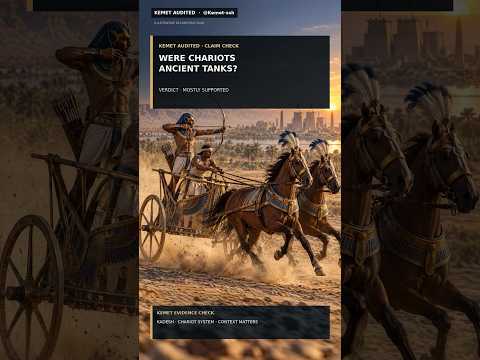
On the open plains of the ancient Near East, the chariot was rarely used as a standalone weapon but rather as the tip of a spear. According to records on Egyptian chariotry, the primary tactical doctrine was the delivery of a first strike. In this role, the chariots would charge toward the enemy lines, using their speed to create a psychological and physical impact. This was not meant to be a suicidal collision; instead, the goal was to create "breakthroughs" or gaps in the enemy’s formation. Once these gaps were opened, infantry units would immediately follow to exploit the chaos and finish the engagement.
The synergy between the chariot and the foot soldier was the key to Egyptian military success. According to Wikipedia, the Egyptian military utilized these tactics most effectively against lines of less-disciplined light infantry or militia forces. The chariots served as a mobile platform for archers, allowing them to rain arrows down on an enemy while staying just out of reach of hand-to-hand combat. This tactic effectively turned the chariot into a form of mobile artillery. Once the enemy line broke under the pressure of the arrows and the speed of the approaching vehicles, the Egyptian infantry would move in to secure the ground.
The Egyptian chariot was designed as a lightweight mobile platform for archery, not a heavy vehicle meant for crashing directly into enemy lines.
This "first strike" doctrine allowed the Egyptian army to dictate the pace of the battle. By initiating the conflict with high-speed maneuvers, they forced the enemy to react rather than act. However, the effectiveness of this strategy was entirely dependent on the quality of the terrain and the discipline of the following infantry. If the ground was too rough for the chariots to maintain their speed, the first strike would lose its momentum, leaving the subsequent infantry advance vulnerable. This reliance on coordination suggests a high level of military training and professionalization within the New Kingdom ranks.
How did the Pharaoh use chariots as a high-speed moving backup?
Beyond the initial charge, the chariot offered a level of tactical flexibility that was previously unknown in ancient warfare. According to Egypt United Tours' analysis of ancient Egyptian war chariots, these vehicles functioned as a high-speed "moving backup" or mobile reserve. Because of their pace, a commander—often the Pharaoh himself—could redeploy a body of chariots to a failing section of the Egyptian battle line within minutes. In a period where communication was limited to visual signals and runners, the ability to physically transport a strike team across the battlefield in such a short time was a massive advantage.
This mobility also allowed for sophisticated flanking maneuvers. The same sources indicate that chariots could circumvent the main body of an opposing army to launch an attack from the rear. This was particularly effective for targeting and disrupting the enemy's leadership. By bypassing the front lines of infantry, the Egyptian chariotry could threaten the enemy commander's position, forcing the entire opposing force to redirect its attention and potentially break its formation. The chariot's speed made it nearly impossible for enemy foot soldiers to catch or intercept these flanking units before they could strike.
The role of the Pharaoh on the battlefield was often tied to this mobile reserve. While royal propaganda frequently depicted the king fighting alone, historical evidence suggests his real power lay in his ability to command these elite chariot units. By positioning himself with a contingent of chariots, the Pharaoh could observe the ebb and flow of the fight and intervene exactly where the line was most fragile. This strategic use of speed allowed the Egyptians to maintain a tactical advantage even when they were outnumbered, provided they had the open space required to maneuver their horses.
Why was the Battle of Kadesh a turning point for chariot tactics?
The Battle of Kadesh, fought around 1275 BCE, remains the most famous example of chariot warfare in the ancient world. According to historical records of the conflict, the battle was a massive confrontation between the Egyptian forces of Ramesses II and the Hittite king Muwatalli II. While Egyptian monuments, such as those at the Ramesseum and Abu Simbel, portray Ramesses II as a lone hero single-handedly charging through thousands of enemy ranks, modern historical analysis presents a far more complex picture. The battle involved thousands of chariots on both sides, demonstrating the scale at which this technology was deployed at the height of the New Kingdom.
The reality of Kadesh highlights both the strengths and the vulnerabilities of the chariot. According to the video description, the conflict was less of a total victory and more of a tactical stalemate that was later reframed by royal propaganda. Ramesses II’s forces were initially caught by surprise, and it was the mobility of his remaining chariot divisions that allowed him to prevent a total rout. The Hittite chariots, which were often heavier and carried three men instead of two, presented a different tactical challenge. This clash of chariot doctrines—the light Egyptian archery platform versus the heavier Hittite assault vehicle—is a central point of study for military historians.
The narrative surrounding Kadesh is a prime example of how the Egyptian state used military technology to bolster the image of the king. While the evidence suggests the battle ended with a peace treaty rather than a total conquest, the depictions of the chariot charge served as a powerful message of Egyptian resilience. The "Kadesh Poem" and the accompanying reliefs show the chariot not just as a tool of war, but as an extension of the Pharaoh’s divine power. This suggests that the chariot's role was as much political and psychological as it was practical, serving as a symbol of the state's technological superiority and the king's personal bravery.
Who were the elite crew members behind the bow and reins?
The effectiveness of a chariot depended entirely on the two-man crew that operated it. According to the video, a typical Egyptian chariot team consisted of a driver and an archer, though occasionally a third person served as a shield-bearer. This division of labor allowed for specialized training; the driver had to manage a pair of high-strung horses at high speeds while navigating uneven terrain, while the archer had to maintain enough stability to fire accurately. Egypt United Tours notes that to keep the vehicle light, the crew had only minimal protection, usually consisting of scale armor made of bronze or stiffened leather and often a simple headband.
The training regimens required for these roles are still a matter of debate among historians, as no specific "training manuals" have survived. However, researchers infer that the coordination between the driver and the archer must have been seamless. Firing a composite bow from a moving, bouncing platform requires immense core strength and a deep understanding of the horses' rhythm. The driver's role was equally difficult, as he had to use his body weight to help balance the light vehicle during sharp turns, preventing it from flipping over on its two wheels.
This specialized skill set led to the rise of an elite class within the military hierarchy. According to Wikipedia, chariotry eventually evolved into a prestigious force, with its members often coming from the upper tiers of society. Being a charioteer was not just a job but a status symbol, requiring the wealth to maintain horses and the time to master the complex skills of chariot combat. This elite status meant that the chariotry often received the best equipment and the closest attention from the Pharaoh, further cementing the vehicle's place as the centerpiece of New Kingdom military life.
What were the terrain dependencies and physical limitations?
Despite its power, the Egyptian chariot was a highly specialized and fragile tool that failed in the wrong environment. According to the Wikipedia entry on Egyptian chariotry, a major tactical limitation was its extreme dependence on "the right terrain." Because the vehicles were built for speed and were extremely lightweight, they were most effective on flat, open ground. In mountainous regions, heavily forested areas, or marshy wetlands, the chariot was not only ineffective but could become a liability. If the wheels became stuck or the horses tripped on uneven ground, the fragile frame could easily shatter, leaving the crew stranded and vulnerable.
The "tank" comparison, often used in popular history to describe the chariot, is a point of contention among scholars. While some tactical analyses compare the chariot's breakthrough capabilities to modern armored vehicles, Wikipedia notes that this comparison is disputed. Unlike a tank, which is designed for heavy impact and armor protection, the Egyptian chariot was unarmored and could be easily disabled by a single well-placed arrow or a spear to a horse. It was a "glass cannon"—high in offensive power but extremely low in defensive durability.
Ancient Egyptian chariots were fragile and terrain-dependent; their effectiveness was significantly diminished or negated in areas that were not flat or open.
This fragility meant that the Egyptian military had to be very selective about where they engaged the enemy. Battles were often sought in open plains where the chariot’s speed could be fully utilized. When the terrain was unfavorable, the Egyptian army had to rely more heavily on its infantry, which sometimes struggled to adapt without the chariot's support. This environmental constraint explains why the chariot remained an elite, specialized tool rather than a replacement for foot soldiers. It was a high-maintenance weapon system that required perfect conditions to achieve its potential.
Why does the study of chariot technology matter today?
The study of the Egyptian chariot is more than just an exploration of ancient warfare; it is a window into the technological and social structure of the Bronze Age. According to the research papers on Academia.edu, these vehicles were a primary tool for both warfare and ceremonial contexts, meaning they were central to how the Egyptian state functioned. The ongoing study of leather fragments by archaeological teams, as reported by Ahram Online, is helping modern researchers reconstruct the exact technology and resources used in their construction. Understanding how the Egyptians sourced timber, worked leather, and bred horses provides a clearer picture of their international trade and domestic industry.
Furthermore, the transition of the chariot into an elite force within the military hierarchy, as noted by Wikipedia, reflects the social changes of the New Kingdom. It shows how technology can create new social classes and shift the balance of power within a civilization. The chariot archer was a new kind of warrior who required different support systems than the traditional spearman. This shift towards specialized, high-tech warfare necessitated a more complex bureaucracy to manage the logistics of horse breeding, vehicle maintenance, and specialized training.
Ultimately, the evidence suggests that the chariot was a symbol of the Egyptian state's ability to adapt and innovate. While it had clear physical limitations and was often used in propaganda to exaggerate the Pharaoh's personal power, its role on the battlefield was a functional reality. By combining speed, mobility, and the "first strike" doctrine, the Egyptians transformed the chariot into a tool that helped define the boundaries of their empire for centuries. As modern researchers continue to analyze the physical remains and the historical records of battles like Kadesh, the chariot remains a testament to the sophisticated engineering and strategic thinking of the ancient world.
Watch the Kemet filmFirst published on Kemet (kemet-stories.pages.dev) · reference KMT-AB812C
← Back to the archive