
What can a small wooden box from Thebes tell us about life?
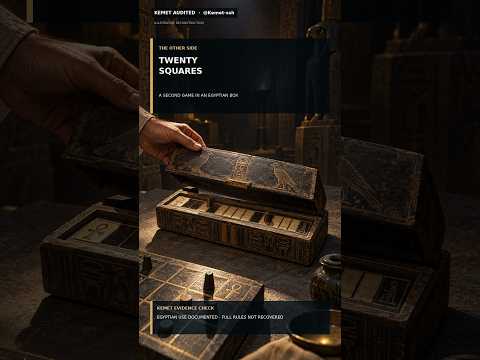
In the silent darkness of an ancient tomb at the site of Thebes, archaeologists uncovered a rectangular box that served as more than just funerary equipment. This object, now housed in museum collections, features a small drawer at one end designed to hold gaming pieces and knucklebones. Upon closer inspection, the box revealed itself to be a dual-purpose entertainment center. While one side featured the thirty-square grid of the well-known game of Senet, the other side presented a distinct track of twenty squares. This discovery, according to documentation from the Metropolitan Museum of Art, illustrates that the ancient Egyptians were not limited to a single form of board game entertainment but instead enjoyed a variety of experiences, some of which were distinctly international in their design.
The physical construction of these gaming boxes highlights the craftsmanship and social status of their owners. The Theban box is not a solitary example; many surviving Egyptian game boards from the New Kingdom are double-sided, often crafted from expensive materials such as ebony and ivory or common faience. The design suggests a culture that valued portability and multi-functional objects. By including a drawer for the storage of casting sticks or knucklebones, the ancient makers ensured that all the necessary components for a match were kept together. This specific layout, with Senet on the top and the twenty-square grid on the bottom, has been confirmed by multiple institutions, including the Rosicrucian Egyptian Museum, and points to a standardized gaming culture that spanned centuries of Egyptian history.
According to the British Museum, the game of twenty squares was not an indigenous invention of the Nile Valley but was instead a cultural traveler. While Senet is deeply rooted in the early history of Egypt, the twenty-square game appeared much later, during the New Kingdom period which lasted from approximately 1550 to 1070 BCE. The evidence suggests that this game was imported from the ancient Near East, where it was already a popular pastime. In Mesopotamia, it was known in a slightly different form as the Royal Game of Ur. Its arrival in Egypt marks a significant moment of cultural exchange, likely occurring during the Second Intermediate Period when the Hyksos people moved into the region or through the expanding trade networks that defined the era.
How did a Mesopotamian import become an Egyptian staple?
Scholars such as those at the American Society of Overseas Research suggest that the introduction of the game of twenty squares coincided with a period of intense international contact. As the Hyksos established their presence in the Nile Delta, they brought with them various cultural elements from the Levant and Mesopotamia. The game likely began as a curiosity but soon gained a permanent foothold in Egyptian society. The British Museum notes that the Egyptians eventually gave the game their own name, Aseb, to distinguish it from other pastimes. This renaming signifies a process of cultural adoption where a foreign object is not just used but is integrated into the local vernacular and lifestyle.
The evidence for this transition is found in the sheer variety of materials used to create Aseb boards across different social strata. In the royal courts, boards were made of the finest woods and inlaid with precious materials, while in the shadows of great monuments, the common people scratched the same twenty-square grid into the stone floors of temples. This suggests that once the game arrived, it permeated every level of society. Records from the Petrie Museum of Egyptian Archaeology show that the game remained in use for over 1,500 years, with versions of the grid appearing in graffiti from the Late Period and into the Graeco-Roman era. This longevity indicates that the game was not a passing fad but a deeply ingrained part of the Egyptian social fabric.
Unlike Senet, which was linked to the soul's journey, Aseb was primarily a secular race game.
Despite its foreign roots, the game was fully embraced by the highest levels of the Egyptian state. Excavation reports from the Valley of the Kings reveal that even the boy king Tutankhamun was a fan of the game. According to the Griffith Institute at the University of Oxford, three twenty-square boards were discovered among the extensive funerary equipment in tomb KV62. The presence of these games in a royal tomb suggests that the pharaoh expected to continue enjoying the pastime in the afterlife. The transition from a foreign import to a royal necessity confirms that by the time of the 18th Dynasty, Aseb was as much a part of Egyptian identity as the indigenous games that had existed for a thousand years prior.
What was the physical layout of an Aseb board?
The geometry of the twenty-square game is distinct and recognizable to modern archaeologists. According to the Metropolitan Museum of Art, the board typically consists of two main parts: a block of twelve squares arranged in a three-by-four grid and a long central row or "handle" consisting of eight squares. This totals twenty squares, which gave the game its modern descriptive name. This specific layout is standard across most museum collections and distinguishes it immediately from the thirty-square Senet board. The two games often share the same box, but their paths and logic are entirely different, requiring players to switch their tactical approach when they flip the board over.
Most Egyptian game boxes were designed with a sense of balance and symmetry. The long track of eight squares usually extends from the middle of the three-by-four block, creating a shape that some researchers compare to a handle or a neck. This layout is essentially a race track. The Metropolitan Museum of Art describes the game as a two-person race where players competed to move their pieces down the side rows and then into the central row. This central row served as the primary arena of competition, where pieces could potentially be blocked or captured, depending on the specific rules of the era. The physical structure of the board dictates the flow of movement, leading the players toward a final goal at the end of the long track.
The materials used in construction provide a window into the ancient economy. Higher-end boards found in elite tombs often used faience, a glazed ceramic that could be colored a vibrant blue or green. In contrast, the Petrie Museum holds fragments of simpler boards made of clay or roughly carved limestone. The consistency of the twenty-square count across these varying materials shows that the game's mathematical structure was more important than its aesthetic presentation. Whether it was played on an elaborate ebony box or a piece of discarded stone, the twenty-square grid remained the fundamental requirement for the experience of Aseb.
How did the ancient Egyptians determine their moves?
The movement of pieces in Aseb was governed by chance, but the tools used to generate that chance were different from the cubic dice familiar to modern players. According to the British Museum, players typically used casting sticks or knucklebones (specifically known as astragali) to determine how many squares a piece could advance. These knucklebones were often taken from the joints of sheep or goats, though more expensive versions were carved from ivory or cast in bronze. A throw of these objects would result in a value that the player would then apply to one of their pieces on the board. This element of randomness ensured that every game was different and required players to manage risk as they navigated the board.
While the exact movement patterns are reconstructed from a combination of archaeological finds and surviving Near Eastern texts, the Metropolitan Museum of Art notes that the game was a "race" where two players competed against each other. Each player usually started with a set of five pieces. These pieces were often shaped as small cones or spools, a design that likely helped players distinguish them from the seven pieces typically used in some versions of Senet. The use of five pieces per player is a standardized count found in many New Kingdom sets, such as those in the Brooklyn Museum. Having five pieces allowed for more complex strategies than a single-piece race, as a player had to decide whether to advance a lead piece or bring up the rear.
No original instruction manual for the Egyptian version of the game has ever been found.
The strategy involved moving pieces through the side rows of the three-by-four block before entering the long central row. The central row was the contested space. Evidence from the British Museum suggests that specific squares on the board were marked with rosettes or hieroglyphs, such as the nefer sign, which represents beauty or goodness. These marked squares likely functioned as safe squares or provided additional turns, helping players navigate toward the end of the track.
What makes Aseb different from the better known Senet?
One of the most significant differences between Aseb and Senet lies in their perceived purpose. Senet, over its long history, evolved from a simple pastime into a deeply symbolic activity with religious overtones. By the New Kingdom, Senet was seen as a metaphor for the journey of the Ba, or the soul, through the hazards of the underworld. However, the game of twenty squares appears to have followed a different path. According to the British Museum and the Metropolitan Museum of Art, Aseb remained a largely secular game throughout its history in Egypt. While Senet boards were often inscribed with funerary spells and religious imagery, twenty-square boards usually lacked this heavy spiritual weight.
This secular nature is a point of minor debate among scholars. Some researchers, such as Irving Finkel, have suggested that certain squares on the twenty-square board might have held minor ritual meanings or represented specific omens. However, the prevailing view in the academic community is that Aseb was primarily a game of skill and luck played for entertainment rather than spiritual progression. This distinction is reflected in where the boards are found. While both games appear in tombs, Aseb is also frequently found in domestic settings and as casual graffiti in non-religious areas of temples, suggesting it was a game of the "here and now" rather than the "hereafter."
The lack of religious baggage may have contributed to the game's popularity as a social bridge. Because it was a secular pursuit, it could be played by anyone regardless of their specific funerary preparations. The Metropolitan Museum of Art highlights that both players determined their moves using the same casting sticks, making it a fair and balanced competition. In Senet, the movement across the final squares was often laden with symbolism about passing into the kingdom of Osiris. In Aseb, the final squares were simply the end of the race, representing a victory in a game of wits and probability.
How did the Egyptians adapt the game to their own culture?
When the game of twenty squares arrived in Egypt, it did not stay exactly as it was in Mesopotamia. The Egyptians were known for their ability to adopt foreign concepts and "Egyptianize" them. This is most visible in the decoration of the boards. On the original Near Eastern boards, such as those found at Ur, the special squares were almost always marked with rosettes. According to the British Museum, Egyptian versions of the game often replaced these rosettes with hieroglyphic symbols. The nefer sign is one of the most common replacements, but other symbols representing luck or protection were also used.
This change in decoration might seem purely aesthetic, but it reveals how the Egyptians made the game their own. By using hieroglyphs, they integrated the game into their visual language. It is unknown if these signs changed the fundamental mechanics of the game or if a nefer sign functioned exactly like a Mesopotamian rosette. However, the substitution shows that the game was not seen as a foreign curiosity but as a standard part of the Egyptian gaming repertoire. The Metropolitan Museum of Art points out that even the physical shape of the board sometimes shifted slightly to fit the standard dimensions of Egyptian gaming boxes, which were often manufactured in sets.
The adaptation also extended to the name of the game itself. While the Mesopotamians may have used different terminology, the term Aseb is found in Egyptian records. This linguistic shift is confirmed by the Petrie Museum of Egyptian Archaeology. The fact that a specific Egyptian word was coined or adapted for the game indicates that it was a recognized category of activity. This cultural blending is a hallmark of the New Kingdom, an era defined by its cosmopolitan nature and its willingness to incorporate the best elements of the surrounding world into the life of the Nile.
What remains unknown about the rules of Aseb?
Despite the abundance of boards and pieces, a complete "instruction manual" for Aseb in Ancient Egypt has never been discovered. While scholars have a much better understanding of the Mesopotamian rules thanks to a cuneiform tablet translated by researchers at the British Museum, it is not certain that the Egyptians played by those exact same rules. Archaeological evidence can tell us where the pieces were placed and what the boards looked like, but the nuances of play—such as whether a piece could "jump" over another or if players could move multiple pieces in one turn—remain a matter of scholarly inference rather than confirmed fact.
One of the most persistent debates involves the "neck entry" or the starting point of the game. It is still debated exactly which square was the starting square for the Egyptian version of the game. Some scholars argue that pieces entered from the side of the three-by-four block, while others suggest the entry point was at the far end of the long row. While researchers can reconstruct the board, the specific path remains a topic of scholarly discussion. Without a written set of rules from an Egyptian source, researchers must rely on the geometry of the board and the wear patterns on surviving pieces to guess how the ancients navigated the twenty squares.
Another mystery involves the decline of the game. Aseb remained popular for over a millennium, but it eventually began to fade from the archaeological record during the late Roman period. Why a game with such staying power eventually disappeared while others survived remains unclear. Archaeological records indicate that other games like the Roman Latrunculi began to rise in popularity during this time. It is possible that as the cultural influence of the Roman Empire grew, the older "Egyptianized" games were replaced by newer trends from across the Mediterranean, leading to the eventual abandonment of the Aseb board.
Why does the evidence of Aseb still matter today?
The study of the game of twenty squares offers a unique perspective on the ancient world that goes beyond the grand narratives of wars and dynasties. It provides a glimpse into the daily lives and leisure activities of people who lived thousands of years ago. By examining the boards found at Thebes or the ivory pieces from Tutankhamun’s tomb, we can see that the ancient Egyptians valued play, competition, and intellectual challenge. The existence of Aseb serves as a reminder that culture is not static; it is a living thing that grows through contact, trade, and the sharing of ideas across borders.
According to the British Museum, the game's 1,500-year history in Egypt is a testament to the stability and longevity of Egyptian society. Even as empires rose and fell, the simple act of throwing knucklebones and moving pieces across a twenty-square grid remained a constant. The transition of Aseb from a foreign import to a local tradition illustrates the inclusive nature of Egyptian culture during the New Kingdom. It shows a society that was confident enough in its own identity to take the best of what its neighbors had to offer and make it uniquely its own.
Today, these boards are more than just museum artifacts; they are puzzles that continue to challenge modern scholars. Institutions like the Metropolitan Museum of Art and the Petrie Museum continue to study these objects to better understand the mathematical and social logic of the past. While the full rules may remain lost to time, the evidence we do have—the ebony boxes, the faience pieces, and the scratches on temple floors—speaks of a universal human desire for entertainment and connection. Aseb reminds us that across thousands of years and vast geographical distances, the joy of a well-played game remains a powerful link between the ancient world and our own.
Watch the Kemet filmFirst published on Kemet (kemet-stories.pages.dev) · reference KMT-62D531
← Back to the archive